Delhi University CSAS UG 2026: everything students need to know about the registration process
Delhi University has opened undergraduate admissions for the 2026-27 session through its Common Seat Allocation System, known as CSAS. If you cleared CUET UG 2026 and want a seat in one of DU’s colleges, this is the portal you’ll be living on for the next few weeks. Here’s what’s actually happening, in plain terms, and what you need to do next.
What is DU CSAS and why it matters this year
CSAS is the single online system Delhi University uses to register candidates, collect preferences, and allot seats across its constituent colleges. It replaced the old college-wise application process a few years ago, so instead of applying separately to each college, you fill one form and rank your programme-college combinations.
For 2026-27, DU is offering more than 71,000 undergraduate seats across 79 UG programmes, spread over its constituent colleges. Every one of those seats is being filled purely on CUET UG 2026 scores, matched against each programme’s specific eligibility rules. There’s no separate DU entrance test for general UG admission; CUET is the only gate.
DU UG registration 2026: key dates
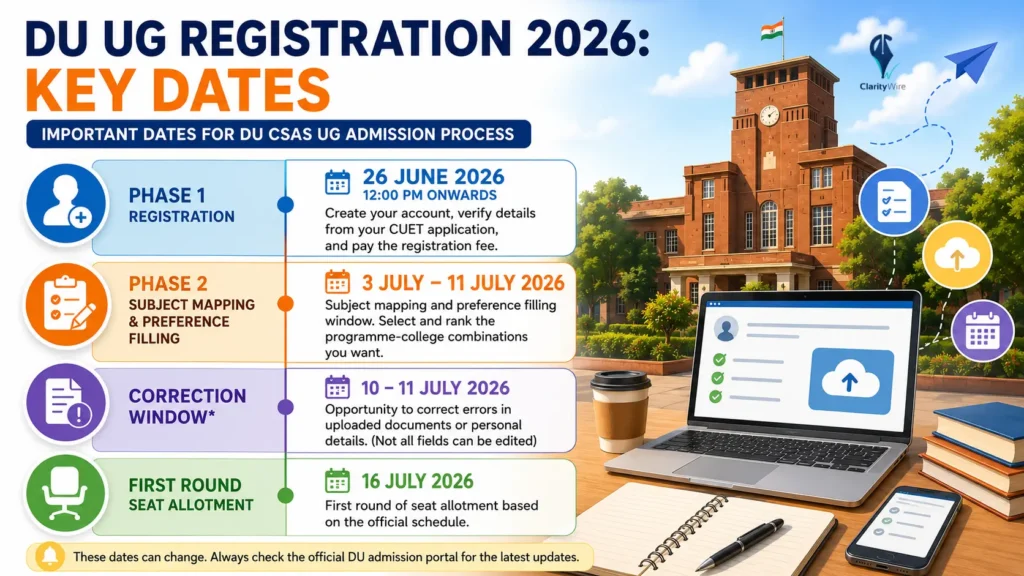
Delhi University CSAS UG registration opened in two stages this year.
- Phase 1 began on 26 June 2026 at 12:00 PM. This is where you create your account, verify details pulled from your CUET application, and pay the registration fee.
- Phase 2 started on 3 July 2026 and runs through 11 July 2026. This phase covers subject mapping and preference filling, where you select and rank the actual programme-college combinations you want.
- A correction window is expected to open around 10-11 July 2026 for candidates who need to fix errors in uploaded documents or personal details, though not every field can be edited at this stage.
- The first round of seat allotment is expected on 16 July 2026, based on the official schedule released by the university.
Because these dates have shifted before and can shift again, it’s worth checking the official DU admission portal directly rather than relying on any single article, including this one.
Where to register: the official portal
All CSAS UG registration happens at ugadmission.uod.ac.in, with notices and schedules posted on admission.uod.ac.in. DU does not accept offline forms for any undergraduate programme. If a site other than these two asks you to pay a fee or upload documents, it isn’t the university, and you should not enter any information there.
Who can register
You’re eligible for DU CSAS UG 2026 registration if you:
- Appeared for CUET UG 2026 and have a valid CUET application number and password
- Meet the programme-specific eligibility criteria set by DU for your chosen course
- Have passed Class 12 from a recognised board
- Meet the subject-mapping requirement between your Class 12 subjects and the CUET papers you attempted
There’s no upper age limit for undergraduate admission at DU, and a gap year isn’t a barrier as long as you’ve appeared in CUET UG 2026.
Documents to keep ready before you start
Have scanned copies of these ready before you log in, since the process moves faster if you’re not scrambling for a document mid-form:
- CUET UG 2026 application number and password
- Class 10 and Class 12 mark sheets and certificates
- A recent passport-size photograph and scanned signature
- Category certificate, if you’re applying under SC/ST/OBC-NCL/EWS/PwBD
- Certificates for ECA (extracurricular activities) or sports quota, if applicable
- A valid ID proof
Use the same email ID and mobile number you registered with for CUET, since it keeps your login consistent and avoids OTP mismatches later.
Step-by-step: how to complete DU CSAS UG registration 2026
- Go to ugadmission.uod.ac.in and click on New Registration.
- Log in using your CUET UG 2026 application number and password.
- Verify the personal details that get auto-fetched from your CUET application. Some fields, like your name, photograph, and signature, are locked and can’t be edited here.
- Fill in your Class 10 and Class 12 academic details.
- Upload the required documents in the specified format and size.
- Pay the registration fee online. The amount depends on your category: Rs. 250 for General, OBC-NCL, and EWS candidates, and Rs. 100 for SC, ST, and PwBD candidates. If you’re applying to BFA, B.A. (Hons.) Music, or B.Sc. (Physical Education, Health Education and Sports), add another Rs. 400. Claiming an ECA or Sports supernumerary seat adds Rs. 100 per quota. All of these fees are non-refundable.
- Once Phase 2 opens, log back in to map your subjects and fill your programme-college preferences in order of priority.
- Review everything before final submission, and download the confirmation page for your records.
A few mistakes worth avoiding
Preferences, once locked, generally can’t be changed, so don’t rush this part. Rank colleges and programmes based on where you’d actually enrol, not just what looks impressive on paper. Double-check that the name on your category or reservation certificate matches your school board certificates and your CUET registration exactly; mismatches here are one of the most common reasons applications get flagged. And keep checking the CSAS portal directly for updates rather than relying on forwarded messages or unofficial WhatsApp groups, since schedule extensions and corrections are announced there first.
What happens after registration: the allotment process
Once Phase 2 preferences are locked, DU releases seat allotment in rounds:
- Round 1, the initial allotment, is based on your CUET score and the preferences you submitted. If you get a seat, you’ll need to accept it online within the deadline and then complete document verification at the allotted college.
- Round 2 and beyond allow you to upgrade to a higher preference if you’re not satisfied with your first allotment, followed by further rounds and spot rounds depending on seat availability.
Missing a deadline at any stage, whether it’s accepting a seat, uploading a document, or paying the admission fee, can lead to your allotted seat being cancelled. So once the portal opens a window for you, it’s worth acting on it the same day rather than waiting.
Quick FAQ
Is CUET UG 2026 compulsory for DU admission?
Yes. All undergraduate admissions for 2026-27 are based solely on CUET UG 2026 scores combined with programme-specific eligibility.
Can I edit my CSAS form after submitting it?
Only within the correction window DU announces, and only for specific fields. Category, gender, and the courses you’ve applied for typically can’t be changed.
How many UG programmes can I apply for?
DU is offering 79 undergraduate programmes this year, and candidates can apply to as many as they’re eligible for, though the selection can’t be edited once submitted.
What’s the registration fee?
Rs. 250 for General, OBC-NCL, and EWS candidates, and Rs. 100 for SC, ST, and PwBD candidates. BFA, Music, and PE/HE&S applicants pay an extra Rs. 400, and ECA or Sports quota claims add Rs. 100 each. All payments are non-refundable.
Common questions students keep asking about DU CSAS
Beyond the basics, most of the confusion around DU CSAS comes from what happens after you submit your preferences, not before. Here’s what’s actually tripping people up this admission cycle.
What is subject mapping, and why does it matter?
Subject mapping is how DU matches the CUET papers you appeared for against your Class 12 subjects to decide which programmes you’re eligible for. Only the language and domain-specific papers you actually passed in Class 12 get counted. If your mapping is wrong or incomplete, programmes you expected to see as options simply won’t show up in your preference list, and there’s no separate appeal process for this beyond the correction window.
What’s the difference between Freeze and Upgrade after a seat is allotted?
Once you’re allotted a seat and accept it, you choose one of two paths. Freeze means you’re happy with the allotment and are opting out of any further rounds, so your seat stays exactly where it is. Upgrade means you’re open to a better preference in the next round; if you get upgraded, your current seat is cancelled automatically and replaced with the new one. If you get upgraded but then don’t act on the new seat within the deadline, you lose it entirely and drop out of CSAS.
What happens if I don’t respond at all after getting a seat?
Inaction isn’t neutral. If you neither freeze nor upgrade within the given window, your existing seat is retained, but you’re locked out of upgrading in any later round. So sitting on your hands effectively means you’ve accepted whatever you already have.
How many college-programme combinations can I select as preferences?
There’s no fixed cap. You can add as many programme-college combinations as you’re eligible for based on your subject mapping. The order matters more than the count, though, since the allocation algorithm works down your list and stops at the first preference your CUET score qualifies you for.
Can I change my preferences after locking them?
No. Once the preference-filling window closes and your list is locked, it’s final. The only way to move to a better option afterward is through the Upgrade mechanism in subsequent rounds, which only considers preferences already saved above your current seat.
What is a Spot Round, and who can apply for it?
If seats are still vacant after all the regular allocation rounds, DU opens a Spot Round to fill them. Only candidates who registered for CSAS but weren’t admitted to any college so far are eligible. There’s no upgrade or withdrawal option in a Spot Round; whatever seat you get here is final, and accepting it is mandatory if you want to keep your admission chances alive.
Can I withdraw my admission after accepting a seat?
Yes, through the CSAS dashboard, but it isn’t free. A withdrawal carries a non-refundable fee, and once you withdraw, you’re out of that admission cycle for good, including any subsequent regular rounds.
What is a Simulated Rank, and should I take it seriously?
Before the official allocation list comes out, DU releases simulated ranks, tentative estimates of where you’d likely land in the merit order for each preference, based on your CUET score, category, and the preferences everyone has submitted so far. It’s not your final result, but it’s the closest signal you’ll get before the real thing, and DU usually gives a short window afterward to reorder preferences based on it.
Will DU verify my documents before or after I accept a seat?
After. Once you accept a provisionally allotted seat, the concerned college checks your subject mapping, category certificate, and other uploaded documents against the originals. Getting this wrong at any stage, not just at registration, can still cost you the seat, so keep certified copies handy even after you think you’re done.
Is there any admission without appearing for CUET UG 2026?
No. CUET UG is the only route into DU’s regular undergraduate programmes this year. There’s no separate DU entrance test, no direct-merit route on Class 12 marks alone, and no exception for missing the exam.
This article draws on official notices and schedules published by the University of Delhi on its admission portal (admission.uod.ac.in and ugadmission.uod.ac.in). For the final word on dates, fees, and eligibility, always refer to the University of Delhi’s official CSAS UG bulletin and notifications, since schedules can be revised.
Related reading
Once you’ve registered, a few more things are worth sorting out before the seat allotment rounds begin:
- Documents required for DU admission 2026 — the full list of certificates and papers colleges actually check during verification.
- How to build your CUET UG preference list for DU colleges — how to rank programme-college combinations so you don’t waste your CUET score.
- Freeze, upgrade, or withdraw: what to do after a seat is allotted — a breakdown of the three options and what each one locks you into.