Delhi University just opened a one-year Master's degree. Here's who can actually apply
If you finished a four-year undergraduate degree at Delhi University this year, there’s a new door open to you that didn’t exist for any batch before yours: a Master’s degree in one year instead of two.
DU started accepting applications for this on July 5, 2026, and the window closes July 11 at 11:59 pm. It’s not open to everyone. It’s not open to every subject. And it runs alongside the regular two-year PG admissions that are also happening right now on a separate track. Mixing these two up is the easiest mistake to make this admission season, so this piece walks through both, and where they overlap.

What the one-year PG programme actually is
This is DU’s rollout of the multiple-entry, multiple-exit structure promised under the National Education Policy (NEP) 2020. Until now, a Master’s at DU meant two years, no matter what you’d already covered as an undergraduate. That changes for one specific group.
According to the university’s own notice, the one-year PG programme is being offered to students who completed a four-year undergraduate degree under the Undergraduate Curriculum Framework (UGCF) 2022, which is DU’s NEP-aligned four-year course structure introduced in 2022.
In plain terms: if you did the older three-year BA or BSc, this doesn’t apply to you. If you did the four-year UGCF 2022 degree but picked up your subject only as a minor, it also doesn’t apply. You need the four-year degree with that subject as your major.
Seats aren’t unlimited either. Each department has set aside a portion of its total PG intake for this track, generally starting around 20 percent of the sanctioned seats and capped at 45 seats, with some flexibility for smaller humanities departments and lab-heavy science departments where equipment and space limit numbers.
Who is excluded, at least for now
Not every department is running a one-year option this year. DU has held back a handful of subjects where the four-year undergraduate syllabus doesn’t yet overlap enough with the PG curriculum to compress it safely.
Chinese, Japanese, Korean, Journalism, Linguistics, and Russian will continue on the two-year format, with Russian expected to stay that way until at least 2027-28. Biophysics, Genetics, Forensic Science, MBA, MFA, Physiotherapy, and Public Health also remain two-year programmes, since these already run through their own separate entrance processes.
If your subject isn’t in the one-year list this year, your route to a Master’s is still the standard CUET PG track described below.
How admission is decided
There’s no separate entrance test for the one-year track. Selection is based on merit from your four-year undergraduate result, along with the credits you’ve already earned and how much your subject overlaps with the PG syllabus.
DU has also built in a rule to stop students repeating content: if more than 30 percent of what you studied in your fourth year overlaps with the PG syllabus, you won’t be made to sit through those PG papers again. There’s a related provision, Recognition of Prior Learning, that can exempt four-year graduates from some first-year PG courses even on the two-year track, provided they completed at least four Discipline-Specific Electives in their final undergraduate year.
How to apply: CSAS PG login, step by step
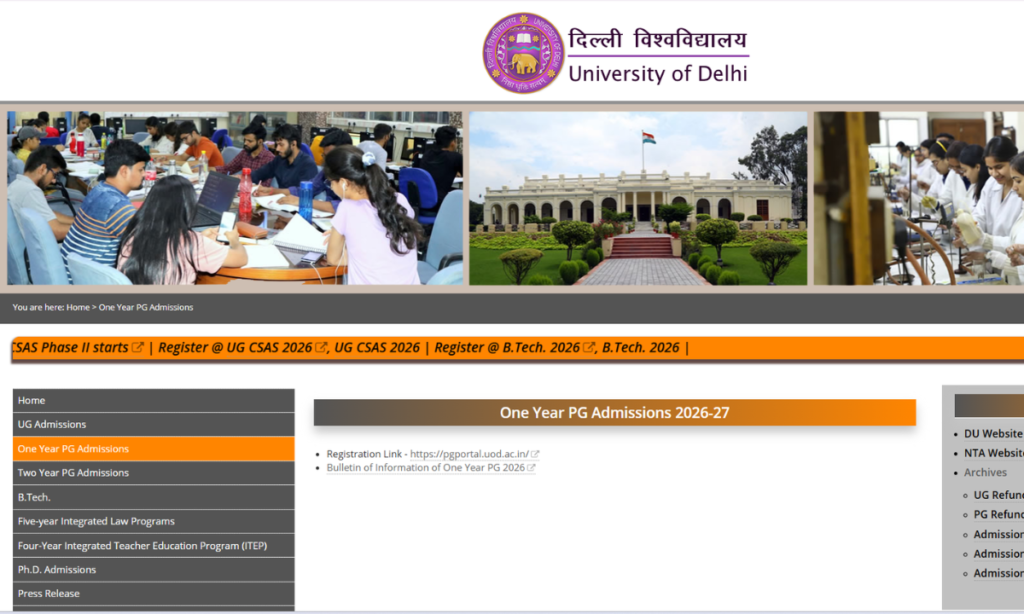
The one-year PG application runs through the same admission portal DU uses for its regular postgraduate intake.
- Go to the official portal at admission.uod.ac.in.
- Log in with your existing CSAS credentials if you’ve used the portal before as a DU undergraduate, or register fresh if this is your first time on it.
- Select the one-year PG option for your department and confirm your eligibility details (degree type, major, credits earned).
- Upload your undergraduate marksheets and any other documents your department asks for.
- Submit before July 11, 11:59 pm. There’s no fee-payment step at this stage since it’s a merit list, not a seat allotment round yet, but check your department’s page for anything extra it wants.
Keep your UGCF 2022 marksheet and any credit certificate handy before you start. Portals under heavy traffic tend to time out midway through a form, and re-entering everything from scratch is the last thing you want the night before a deadline.
This is separate from CUET PG and the CSAS (PG) 2026 cycle
Here’s where the confusion usually starts. DU is currently running two different postgraduate admission processes at the same time.
The regular two-year PG admissions still go entirely through CUET PG, conducted by the National Testing Agency, followed by registration on the Common Seat Allocation System (CSAS) for PG. For the 2026-27 session, DU has stated plainly that admission to all PG programmes will be based solely on CUET PG 2026 scores, and CSAS (PG) registration is mandatory for every college under the university.
That cycle has its own timeline running in parallel: a mid-entry and correction window that closed July 5, a third CSAS (PG) allocation list due July 9, and fee payment and document verification for that round wrapping up by July 13. The university has reported around 9,500 admissions already completed under this two-year track as of early July.
The one-year PG track doesn’t touch CUET PG at all. It’s a separate merit-based route for a specific group of DU’s own four-year graduates. If you’re coming from outside DU, or you did a three-year degree anywhere, CUET PG and CSAS (PG) is still the only door for you.
About that CUET PG cutoff
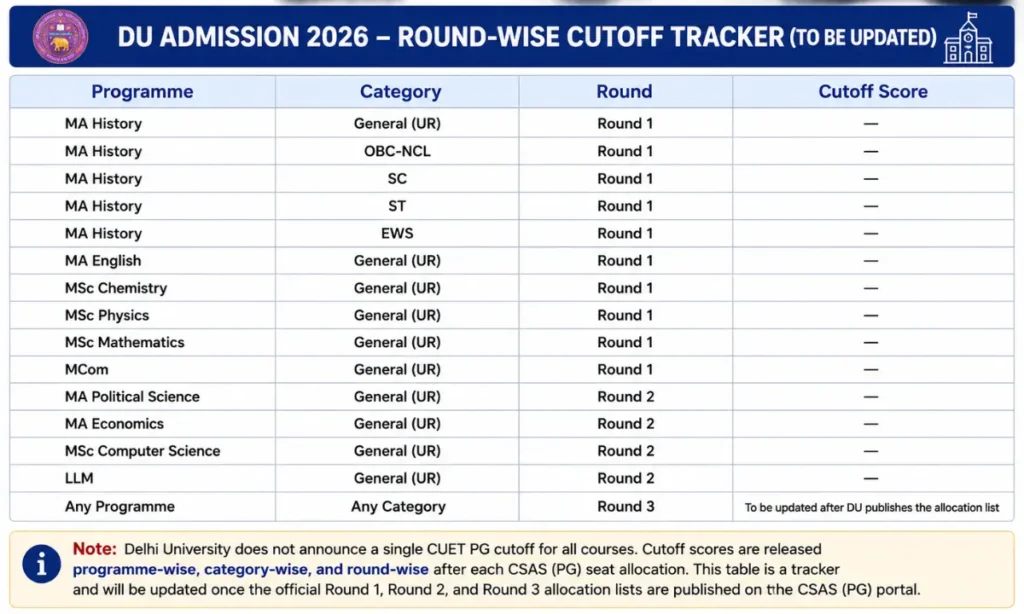
If you’re searching for a fixed CUET PG 2026 cutoff score, there isn’t one published as a single number, and there won’t be. Cutoffs at DU are set separately for each programme and each category (General, OBC-NCL, SC, ST, EWS, PwD) after every allotment round, based on how many candidates applied and how the merit list actually filled up.
What that means practically: a cutoff for MA History in the general category tells you nothing about MSc Chemistry in the OBC category. The only reliable place to check is the seat allocation list published on the CSAS PG portal itself after each round, not aggregator sites quoting last year’s numbers as if they’ll repeat.
| Programme | Category | Round | Cutoff Score |
|---|---|---|---|
| MA History | General (UR) | Round 1 | — |
| MA History | OBC-NCL | Round 1 | — |
| MA History | SC | Round 1 | — |
| MA History | ST | Round 1 | — |
| MA History | EWS | Round 1 | — |
| MA English | General (UR) | Round 1 | — |
| MSc Chemistry | General (UR) | Round 1 | — |
| MSc Physics | General (UR) | Round 1 | — |
| MSc Mathematics | General (UR) | Round 1 | — |
| MCom | General (UR) | Round 1 | — |
| MA Political Science | General (UR) | Round 2 | — |
| MA Economics | General (UR) | Round 2 | — |
| MSc Computer Science | General (UR) | Round 2 | — |
| LLM | General (UR) | Round 2 | — |
| Any Programme | Any Category | Round 3 | To be updated after DU publishes the allocation list |
Key dates at a glance
| Event | Date |
|---|---|
| One-year PG registration opens | July 5, 2026 |
| PG mid-entry and correction window (two-year track) | July 3 to July 5, 2026 |
| One-year PG registration closes | July 11, 2026, 11:59 pm |
| Third CSAS (PG) allocation list (two-year track) | July 9, 2026 |
| Two-year PG allocation and fee payment deadline | July 13, 2026 |
Dates on university portals do shift, sometimes by a day or two, so treat the CSAS PG portal itself as the final word over any secondary source, including this one.
What to do next
If you’re a DU four-year UGCF 2022 graduate: check whether your subject is on this year’s one-year list, confirm your credits meet your department’s threshold, and get your application in before July 11.
If you’re applying through the standard route: your priority right now is tracking your CUET PG result against the CSAS (PG) allocation rounds, not chasing a cutoff number that doesn’t exist yet in a fixed form.
Either way, the CSAS PG portal at admission.uod.ac.in is where every real update will show up first. Bookmark it, check it directly, and treat anything else, including aggregator blogs, as a summary rather than a source.
Sources: University of Delhi official admission portals (admission.uod.ac.in, pgadmission.uod.ac.in) and DU’s public notices on the 2026-27 admission cycle. Credit for the underlying admission rules, dates, and eligibility criteria goes entirely to the University of Delhi; this article simplifies publicly available university information for readers and carries no independent authority over admission decisions. For the binding version of any rule mentioned here, refer directly to the University of Delhi’s official website.
Brought to you by claritywire.in