
DU ECA Quota 2026: Eligibility, Seat Matrix, Colleges and How to Apply
While another person spends her nights at a Kathak studio rather than attending a coaching class, while another person debates for three years at state levels and another draws pictures much more than she reads her textbooks; Delhi University designed the ECA quota just for these kinds of students. In the year 2026-27, DU has released 1,370 seats for UG studies in DU under this ECA quota and the quota process happens side by side with CUET rather than being a replacement to it.
In this guide, we will be explaining what this quota is, how the marks of CUET and talent marks are calculated for this quota, what kind of students can avail this quota and the list of colleges that offer this ECA quota.
What Is the ECA Quota in DU?
The acronym “ECA” stands for Extra Curricular Activities. This is a supernumerary quota which means that the number of seats offered under this ECA quota are extra from the sanctioned intake of seats in DU colleges and do not affect the number of seats offered to students based on CUET merit.
For 2026-27, admissions under ECA are being offered across 14 categories: theatre, Indian classical dance, Indian folk dance, western dance, vocal music, instrumental music, debate (Hindi and English), creative writing (Hindi and English), sketching and painting, photography, choreography, yoga, NCC and NSS. Each college decides which of these categories it actually offers, so the list varies from one college to the next – always check the seat matrix on the CSAS portal for a specific college before assuming a category is available there.
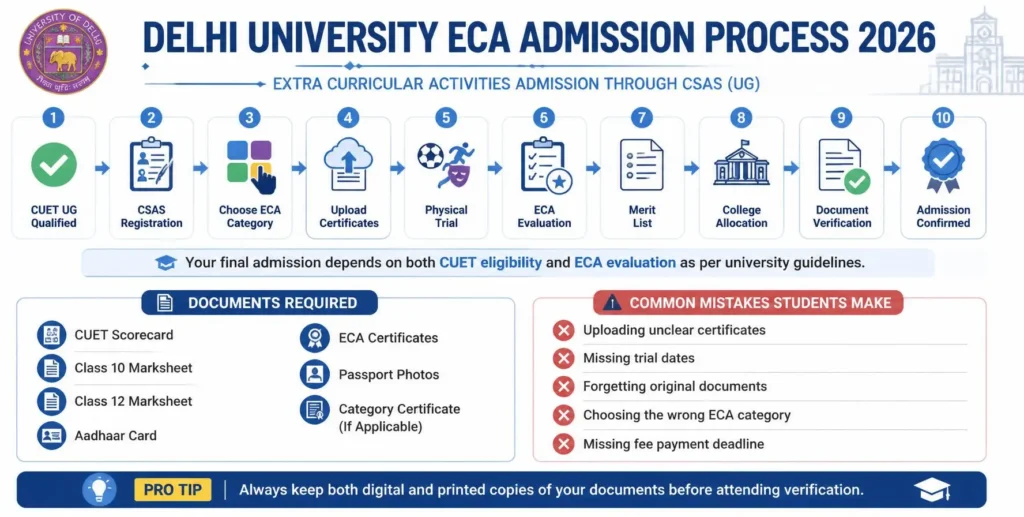
Delhi University ECA Quota Criteria
Two things decide whether a candidate gets in: a CUET UG score, and performance in the ECA evaluation itself. Here’s the split DU has fixed for 2026-27.
- 25% weightage goes to the candidate’s CUET UG 2026 score for the applied programme.
- 75% weightage goes to the ECA component – physical trials or auditions, plus certificate evaluation.
A high CUET percentile isn’t compulsory to apply under ECA, but candidates do need a valid CUET UG score, since it still feeds into 25% of the final number. What actually decides most cases is the trial. Only students who clear the trial round move forward for seat allotment, so a strong certificate portfolio without a solid trial performance usually isn’t enough.
What Is an ECA Certificate in DU?
An ECA certificate is proof of participation or achievement in one of the recognised categories – issued by a school, state body, national federation, or a recognised cultural/sports organisation, for events held within the eligibility window DU sets for that admission cycle (DU has historically used a multi-year window, so check the current cycle’s dates on the CSAS portal rather than assuming). Certificates get scored on parameters like the level of the competition (school, district, state, national, international), whether the achievement was individual or group, and the position secured. Candidates typically upload up to five certificates, and the best three are counted toward the final score.
What Is the Quota Marks for ECA?
The ECA component carries a maximum of 75 marks. For most categories other than NCC and NSS, roughly 60 of those marks come from the physical trial or audition, and up to 15 marks come from certificate evaluation. Group activities – apart from theatre – usually see a deduction of a mark or so per group event, since DU weighs individual performance more heavily than team participation. Add the 25% CUET weightage on top of this 75-mark ECA score, and you get the candidate’s final Combined ECA Merit (CEM), which is what actually decides the seat.
What Is the ECA Supernumerary Quota in DU?
It’s the formal name for this entire admission route. “Supernumerary” simply confirms these seats are additional to a college’s regular intake capacity – so a college admitting, say, 100 students through CUET merit in a programme can still admit a handful more through ECA and sports quotas without touching that regular count. DU colleges are generally directed to keep combined ECA and sports quota seats within around 5% of total intake, split roughly evenly between the two.
CUET ECA Quota 2026: How the Two Processes Connect
CUET isn’t optional for ECA aspirants. A candidate first appears for CUET UG 2026 like any other applicant, then registers separately on the CSAS-UG portal and opts into the ECA quota during that registration. The CUET score doesn’t gate entry into the trial round on its own, but it does form a quarter of the final merit number, so a reasonably competitive CUET percentile still matters, especially in categories where trial scores end up close between candidates.
DU ECA Seat Matrix 2026: Cut-Off and Category-Wise Seats
DU doesn’t release a numeric cut-off for ECA the way it does for regular CUET-based admission – there’s no percentile threshold published for this quota. Selection instead comes down to where a candidate lands on the Combined ECA Merit list within their chosen category and college, once trials are done.
What DU has released is a seat matrix. The categories with the largest allocation for 2026-27:
|
ECA Category |
Seats |
|
Indian Classical Dance |
125 |
|
Indian Theatre |
123 |
|
Indian Vocal Music |
109 |
|
Indian Folk Dance |
72 |
|
Hindi Debate |
71 |
|
English Debate |
69 |
|
Sketching and Painting |
65 |
|
Western Dance |
63 |
|
Photography |
44 |
|
Yoga |
42 |
|
Tabla |
37 |
|
Choreography |
35 |
|
English Creative Writing |
33 |
|
Hindi Creative Writing |
30 |
Niche instruments carry very few seats – sarod has 2, Indian violin has 5, western flute has just 1 – so competition in those categories, though smaller in absolute numbers, can still be sharp given how few spots exist
DU Sports Quota Seat Matrix 2026
The sports supernumerary quota runs on the same 25:75 CUET-to-trial split as ECA and is evaluated in parallel. DU typically opens sports trials shortly after ECA trials begin, covering disciplines from athletics and team sports to individual games, with seat numbers and disciplines again varying college to college. Candidates should treat ECA and sports as two separate applications within CSAS-UG – a student can’t casually swap categories after registering.
How to Apply for ECA Quota in DU 2026
The DU application form 2026 for ECA runs through the CSAS-UG portal rather than a separate form. The steps:
- Register on the CSAS-UG 2026 portal using your CUET UG 2026 application details.
- Fill in the general registration form and college/programme preferences.
- Select the ECA quota option during registration, then choose the specific ECA category you’re applying under.
- Upload your certificates – up to five, for events within the eligible date window.
- Submit the application and wait for the trial schedule.
- Appear for the physical trial or audition on the date and venue assigned to you. DU released the 2026-27 trial schedule after the correction window closed, with most category trials starting mid-July.
- Once trials conclude, check your Combined ECA Merit and seat allotment status on the CSAS dashboard.
- If allotted a seat, download the allotment letter and proceed with fee payment and document verification within the deadline.
Keep scanned certificates, a passport photo, and your CUET scorecard ready before you start; the portal doesn’t save partial uploads indefinitely.
Colleges Offering ECA Quota in DU
Nearly every constituent college of DU runs some form of ECA admission, though the exact categories on offer differ by college and by year. Colleges known for a strong ECA intake include Miranda House, Lady Shri Ram College for Women, Sri Venkateswara College, Kirori Mal College, Hindu College, Hansraj College, Gargi College, Ramjas College, Shivaji College and Zakir Husain College. Before applying, pull up the current seat matrix for each college you’re interested in – a college might offer theatre and debate but not photography, for instance, and that changes where it makes sense to apply.
LSR ECA Quota
Lady Shri Ram College follows the same university-wide framework – 75% weightage from trial performance and certificate evaluation, 25% from CUET UG score, plus a small additional fee for quota applications. Given how competitive LSR’s regular CUET cut-offs already are (recent years have seen general-category cut-offs push toward the upper 90s in percentile terms for arts and commerce programmes), the ECA route is one of the more realistic paths in for students whose extracurricular record is genuinely strong. As with every DU college, clearing the trial is non-negotiable – certificates alone won’t secure a seat here.
How to Get ECA Quota: A Realistic Checklist
Getting an ECA seat isn’t about ticking a box on the application form. It comes down to:
- Holding genuine, verifiable certificates from recognised competitions or events, ideally at state level or above.
- Being able to perform at that same level in a live trial – DU’s evaluators are checking current skill, not just past paperwork.
- Applying to colleges that actually run trials in your category, rather than assuming every college offers everything.
- Keeping a competitive CUET UG score, since it still accounts for a quarter of the final merit.
- Tracking the CSAS-UG portal closely during the application and trial window, since correction windows and trial dates move fast once released.
Frequently Asked Questions
Q1. What is ECA quota in DU?
It’s a supernumerary admission route at Delhi University for students with strong achievements in extracurricular fields like dance, music, theatre, debate, writing, painting, photography, NCC or NSS. Seats under this quota are additional to regular CUET-based intake.
Q2. What is ECA quota in DU eligibility?
Candidates need a valid CUET UG score for the session, must register for the ECA quota through CSAS-UG, hold certificates for their chosen category within the eligible date window, and clear the physical trial or audition where applicable.
Q3. How to apply for ECA quota in DU 2026?
Register on CSAS-UG with your CUET details, select the ECA quota and category during registration, upload certificates, and appear for the scheduled trial. Seat allotment follows once the Combined ECA Merit list is finalised.
Q4. What is the DU ECA seat matrix for 2026?
DU has released category-wise seat numbers for 2026-27, with Indian Classical Dance (125), Indian Theatre (123) and Indian Vocal Music (109) carrying the largest allocations among the 1,370 total ECA seats.
Q5. Is there a cut-off for DU ECA quota?
No fixed percentile cut-off is published for ECA. Admission depends on a candidate’s rank on the Combined ECA Merit list, calculated from 25% CUET score and 75% ECA trial and certificate marks.
Q6. Which colleges offer ECA quota in DU?
Most DU colleges run some ECA admissions, including Miranda House, LSR, Hindu College, Hansraj College, Kirori Mal College, Ramjas College, Gargi College and Sri Venkateswara College, though available categories differ by college.