
Every time Nitin Gadkari sits down for an interview these days, one question follows him around: why does E20 petrol feel like a punishment for people who never asked for it?
In his recent conversation with journalist Deepak Chaurasia, the Union Road Transport and Highways Minister did what he almost always does when the ethanol question comes up. He defended the policy, pointed to Brazil as the model India is following, and dismissed the mileage and engine-damage complaints as the work of a “petrol lobby” running a paid campaign against him.
It’s a compelling story. It’s also missing some fairly important context and if you’re one of the millions of Indians who’ve watched their two-wheeler or ageing sedan run rougher since E20 became the default at the pump, that missing context matters to your wallet.
Here’s the fuller picture, and why the way E20 has been rolled out deserves more scrutiny than it’s getting.
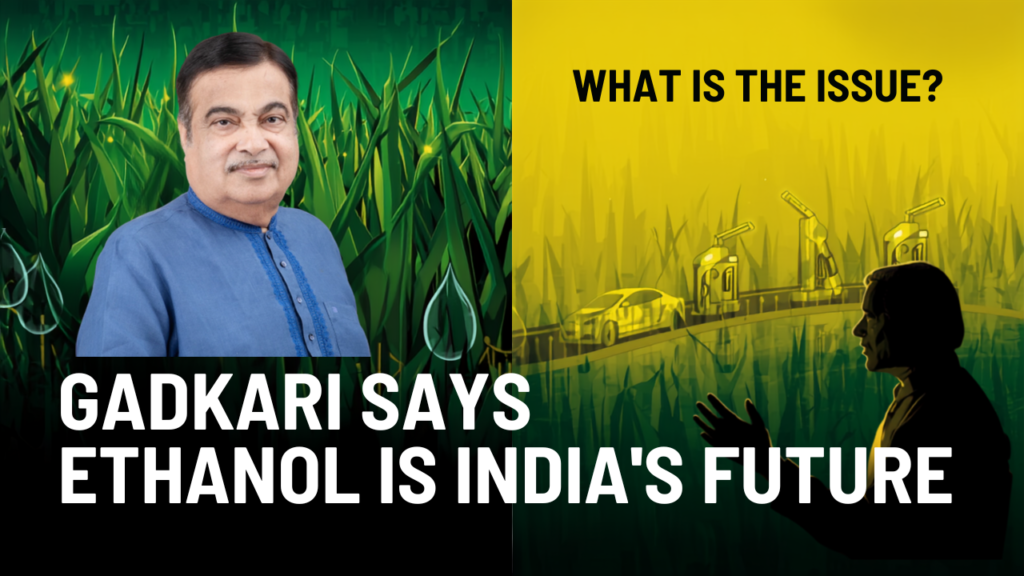
Talking to Deepak Chaurasia, Gadkari stuck to the position he’s held through months of criticism: ethanol blending is good for farmers, good for the economy, and good for the environment, and the backlash against it is manufactured.
This isn’t a new line for him. At the FADA Auto Retail Conclave and again at the Business Today India@100 Summit, he made near-identical arguments that the “petrol lobby is very rich” and behind the social media pushback, and that agencies like ARAI and the Supreme Court had already cleared E20 as safe.
At one event, he went further, rejecting the idea that ethanol policy served his personal interests by insisting his “brain is worth Rs 200 crore a month.”
[Suggested visual: A pull-quote graphic featuring Gadkari’s “petrol lobby” remark alongside a small info-box summarizing the Supreme Court’s dismissal of the PIL against E20.]
To be fair to him, he hasn’t been entirely inflexible. In more recent remarks, he acknowledged that E20 petrol can reduce vehicle mileage because of ethanol’s lower energy density, even while insisting it doesn’t damage engines. That’s a shift worth noting but it also confirms exactly what critics have been saying for a year: this fuel does cost you kilometres per litre, whether or not it damages your car.
My Take: Two Things Gadkari Keeps Getting Wrong in These Interviews
I want to be upfront that what follows is opinion, not just reporting. But it’s an opinion built on watching this rollout unfold in real time, and I think it holds up.
1. This isn’t even his ministry to defend alone
Gadkari is the Road Transport and Highways Minister. Fuel its composition, pricing, and blending targets falls under the Ministry of Petroleum and Natural Gas, headed by Hardeep Singh Puri. Puri has, in fact, made his own public defence of E20, pointing out that Brazil runs E27 without major engine failures and admitting a possible efficiency loss of “up to 3 percent.”
So why is Gadkari the face of nearly every ethanol controversy? Partly because he’s the more visible, quotable minister, and partly because his own family’s ethanol-linked business (more on that below) keeps dragging him back into the conversation. But if E20 is a fuel-blending policy, the petroleum minister not the roads minister should be leading with the technical answers on pricing, labelling, and consumer protection. Splitting the responsibility this way leaves the person who’s actually accountable for pump-level transparency largely out of the public conversation.
2. The Brazil comparison is honest about the destination, not the journey
Gadkari invokes Brazil constantly as proof that high-ethanol fuel works. It’s not a bad reference point – Brazil genuinely is the global benchmark here. But the comparison is incomplete in a way that changes the whole argument.
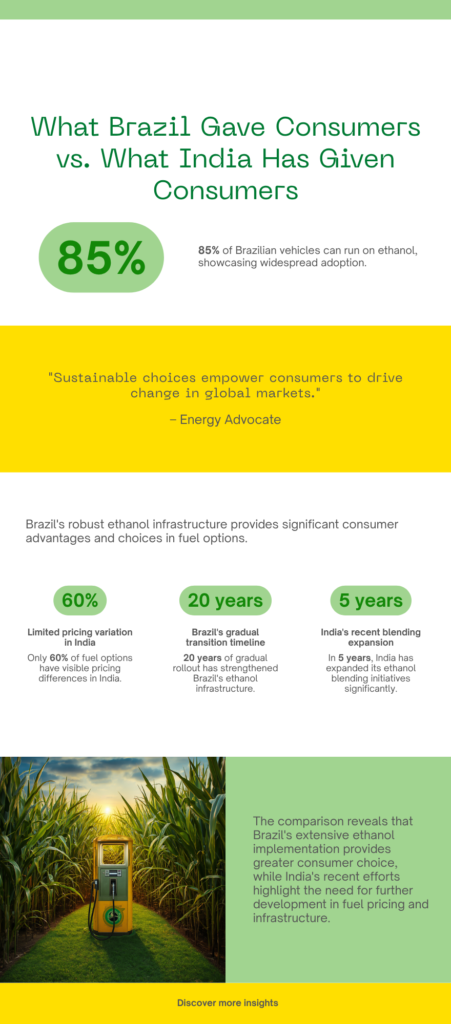
Brazil’s Proálcool program was officially launched on November 14, 1975. Flex-fuel vehicles that could run on any blend of petrol and ethanol only arrived in the Brazilian market in March 2003 nearly three decades later. Even then, it took Brazil just six years to get 90% of new vehicle sales onto ethanol-compatible engines, but that speed was possible because the country built the entire ecosystem pumps, engines, and consumer choice around the fuel from day one.
Crucially, the Brazilian government relied on a mix of voluntary mandates for manufacturers, financing for producers, and tax breaks for buyers of ethanol-compatible vehicles, and it phased subsidies out only once the market had adjusted. And Brazilian motorists have always known exactly what they’re filling their tanks with, because pumps clearly display the blend, unlike in India where there is no such labelling.
[Suggested visual: A side-by-side timeline infographic “Brazil’s Ethanol Journey (1975–2003, 28 years to flex-fuel maturity)” vs. “India’s Ethanol Journey (2003–2025, 20% blending in roughly two decades but full mandatory rollout compressed into a few years).”]
That’s the gap in the “we’re following Brazil” narrative. Brazil gave its citizens time, choice, and clear labelling. India has compressed a decades-long transition into a few years and skipped the choice part entirely.
The Real Problems Nobody in Government Is Fully Addressing
No pump-level disclosure. If you fill your tank today, you often have no simple way of knowing whether you’re getting E10, E20, or a 100-octane ethanol-free option, unless you specifically hunt down premium grades. Reports have confirmed that regular petrol from Indian Oil, HP, BP, and Shell is now uniformly E20, and only the 100-octane premium grades remain ethanol-free. That’s a meaningful choice being made for you, quietly.
Same price, less energy. This is the part that should bother every commuter. E20 is sold at essentially the same price as regular petrol despite delivering roughly 5 to 8 percent less energy per litre, which means you’re paying the same amount for less mileage. Ethanol procurement costs have actually risen past the cost of refined petrol in recent months, which is precisely why the fuel isn’t priced any cheaper at the pump, whatever the original promise was.
Real wear on older vehicles. Ethanol-blended fuel can be corrosive to rubber components like fuel hoses and tends to attract moisture, which is corrosive to engines that aren’t E20 compliant, especially if the vehicle sits unused for a while. Even Gadkari now admits this much, while maintaining it’s not catastrophic.
A legal challenge that didn’t really settle the fairness question. The Supreme Court did reject a public interest litigation that argued E20 had damaged engines and hurt mileage for vehicles not designed for it. But a court dismissing a PIL on procedural or evidentiary grounds isn’t the same as the government proving there’s no unfairness in charging non-compliant vehicle owners the same price for a lesser fuel. Those are two different questions, and the Gadkari camp tends to treat the first as an answer to the second.
What a Fairer Rollout Would Have Looked Like
This is where I’ll lay out my actual opinion plainly, because I think it’s a reasonable middle ground and not an anti-ethanol position.
Ethanol blending itself isn’t the villain here. Cutting India’s fuel import bill, supporting sugarcane and grain farmers, and lowering tailpipe emissions are all legitimate, worthwhile goals. The problem is the execution, not the intention.
A fairer approach would have looked something like this:
- A genuine transition window of 5 to 7 years, during which pure petrol remains available as a clearly labelled option for the tens of millions of vehicles on Indian roads that were never built for E20.
- New vehicles from E20/E85-compliant manufacturers move to blended fuel first, since these cars are engineered for it and owners knew what they were buying.
- Mandatory blend labelling at every nozzle, the way Brazil, the US, and most serious ethanol markets already do, so a scooter owner isn’t guessing what’s going into their tank.
- Full mandatory blending only once the existing non-compliant vehicle fleet has naturally cycled out, not imposed on a fleet that’s still overwhelmingly built for pure petrol.
None of this is radical. It’s close to what Brazil itself did, just compressed into a realistic Indian timeframe instead of India’s actual timeframe, which has been closer to a handful of years for full nationwide rollout.
The Family Business Angle: Why It Keeps Coming Up
No piece on this topic would be honest without addressing why “Nitin Gadkari son company name” is one of the most searched phrases connected to this controversy.
Gadkari’s son, Nikhil Gadkari, owns CIAN Agro Industries, a company that has expanded alongside the government’s ethanol push, and this connection has intensified the criticism directed at the minister. Activist Anjali Damania has accused Gadkari’s sons of wrongdoing related to this expansion, though Gadkari has framed such allegations as politically motivated attacks from fuel-import lobbies that feel threatened by his policies.
To be clear-eyed about this: a minister’s family having business interests in a sector he regulates is not, by itself, proof of corruption. Gadkari has been associated for years with the Purti Group, a conglomerate with interests spanning sugar production, ethanol, and power generation, and he has publicly declared these investments. Public asset declarations put his personal net worth at approximately ₹17.5 crore as of his 2024 election affidavit modest by the standards of Indian political wealth, and a figure that has been independently verified through official election filings.
But the optics problem is real and it’s fair game for scrutiny. When the minister most associated with defending a fast-tracked ethanol mandate has a son whose agro-business sits inside that same ecosystem, the burden of transparency goes up, not down. Dismissing every question as a “paid campaign” doesn’t lower that burden if anything, it raises the question of why a straightforward, itemised rebuttal hasn’t been offered instead.
So Who’s Right Here?
Both things can be true at once, and I think that’s the honest takeaway: ethanol blending is a legitimate long-term energy strategy for a country that imports the overwhelming majority of its crude oil, and the way E20 has been forced onto Indian consumers at full petrol price, without labelling, without a real transition runway for non-compliant vehicles has been unfair to ordinary people.
Gadkari isn’t wrong that India needs to cut its oil import bill. He’s wrong to keep answering “is this fair to the guy with a 2018 Swift” with “look at Brazil” while leaving out the 20-odd years Brazil spent building consumer choice into its own version of this policy.
What You Can Actually Do About It
- Check your vehicle’s compliance. Cars and two-wheelers manufactured from April 2023 onward are generally built to E20 specifications. If yours is older, ask your service centre about ethanol-compatible fuel line and seal replacements during your next service.
- Look for 100-octane, ethanol-free options at major fuel stations if your vehicle is sensitive to blended fuel these remain available at IndianOil, HP, and BP outlets, typically at a premium.
- Don’t let your tank sit near-empty for long stretches, since ethanol’s moisture-attracting properties are more likely to cause problems in vehicles that are parked for weeks at a time.
- Keep your fuel receipts and service records if you notice mileage drops or component wear, in case you ever need to raise a warranty or consumer forum complaint.
- Push for the policy conversation that’s actually missing not “should India use ethanol,” but “why isn’t blend labelling and price differentiation on the table yet.”
The ethanol debate in India isn’t going away, and it shouldn’t. But it deserves a version of the Brazil comparison that includes the twenty years Brazil spent listening to its own drivers before it finished the job.
This article reflects analysis and opinion based on public statements, government data, and reporting from credible outlets including Business Today, Business Standard, India TV, CarDekho, and academic research on Brazil’s Proálcool programme. It is intended to inform public discussion, not to make legal or financial claims about any individual.
Sources referenced:
- Business Today – “‘My brain is worth Rs 200 crore a month’: Gadkari rejects money motive in ethanol row”
- Business Standard- “Gadkari blames petroleum ‘lobby’ for fuelling concerns over E20 rollout”
- India TV News -“‘Paid social media campaign against me’: Gadkari blames ‘petrol lobby'”
- CarToq – “Nitin Gadkari Does A U-Turn: Admits E20 Petrol Can Reduce Fuel Economy”
- CarDekho – “E20 Petrol Blending Issue Explained” (includes Hardeep Singh Puri’s remarks)
- Business Outreach India -reporting on CIAN Agro Industries and Nikhil Gadkari
- National Herald -“E20: The silent experiment at your petrol pump”
- ElectionsGuru.in / MyNeta.info -Nitin Gadkari’s declared assets, 2024 election affidavit
- Wikipedia -“History of ethanol fuel in Brazil”; BIOEN research paper, “40 Years of the Brazilian Ethanol Program (Proálcool)”
- AIDA India – reporting on E20 pricing structure and OMC procurement costs