
New Delhi is hosting world leaders this week, and it is not a small affair. From September 11 to 13, 2026, the capital is playing host to the 18th BRICS Summit, and the city has quite visibly changed shape for it. Roads are closed, schools are shut, and security details are stationed at every major junction near Bharat Mandapam. For a lot of Delhi residents, the first sign that something big is happening was a school circular telling their children to stay home on a Friday.
But there is a much bigger story here than traffic diversions and a day off from school. This summit sits at the intersection of India’s foreign policy ambitions, its economic positioning, and a broader question that has been building for two decades: can a bloc of emerging economies actually reshape how the world is governed, or is BRICS still more symbol than substance? This article walks through what BRICS is, why India hosting it in 2026 matters, what is actually happening in Delhi on September 11, and how this summit compares with the India AI Impact Summit that New Delhi hosted earlier this year.
What does BRICS stand for, and what is the BRICS Summit 2026
BRICS started life as an acronym coined by a Goldman Sachs economist in 2001, grouping Brazil, Russia, India, and China as the emerging economies expected to reshape global growth. South Africa joined in 2010, turning BRIC into BRICS. The first actual leaders’ summit was held in Yekaterinburg, Russia, in 2009.
The group has grown a lot since then. In 2024, Egypt, Ethiopia, Iran, Saudi Arabia, and the United Arab Emirates were admitted as full members. Indonesia joined in 2025. Today, BRICS has eleven full members, plus a widening circle of partner countries such as Belarus, Bolivia, Cuba, Kazakhstan, Malaysia, Nigeria, Thailand, Uganda, Uzbekistan, and Vietnam. Together, this grouping now represents a large share of the world’s population and a growing slice of global GDP, which is exactly why its annual summit gets so much attention.
For 2026, India holds the BRICS Chairship, a role it took over from Brazil on January 1. This is India’s fourth time chairing the group, after 2012, 2016, and 2021. The chairship means India sets the agenda, hosts the ministerial meetings that lead up to the summit, and finally hosts the leaders themselves. According to the official BRICS 2026 website, the grouping expanded in 2024 with Egypt, Ethiopia, Iran, Saudi Arabia, and the UAE all becoming full members, which gives some sense of how much BRICS has changed in just the last two years.
The 18th BRICS Summit is being held at Bharat Mandapam, Pragati Maidan, from September 11 to 13, 2026. Prime Minister Narendra Modi is chairing it. Russian President Vladimir Putin has confirmed attendance, and Chinese President Xi Jinping is expected too, a visit that would carry its own weight given the state of India-China relations over the last few years.
India’s theme for its chairship year is “Building for Resilience, Innovation, Cooperation and Sustainability,” a phrase that doubles as a backronym for BRICS itself. It reflects what officials describe as a “Humanity First” approach, and it lands at a symbolic moment: 2026 marks twenty years since the BRIC grouping was first formalised in 2006.
Why the BRICS Summit matters to India
It is easy to treat a summit like this as diplomatic theatre, handshakes, group photos, communiqués nobody reads in full. That reaction misses what is actually at stake for India on three separate fronts: political, economic, and social.
Politically, hosting BRICS lets India present itself as a bridge between the developed and developing world. India is simultaneously a member of the Quad, alongside the US, Japan, and Australia, and a founding member of BRICS, which includes Russia and China. That dual positioning is not accidental. It lets India speak for the Global South on issues like UN Security Council reform, multilateral trade rules, and international financial architecture, while keeping its Western partnerships intact. Very few countries can occupy that position credibly, and India has spent years building the diplomatic capital to do so.
Economically, BRICS gives India a seat at conversations about de-dollarisation, cross-border payment systems, and the New Development Bank, which funds infrastructure projects across member states. These are not abstract topics. Trade settlement in local currencies, alternatives to the SWIFT payment system, and reform of IMF voting shares all have direct implications for how Indian businesses trade with the rest of the world. India has been notably cautious here. Unlike Russia or Brazil, it has not pushed hard for a common BRICS currency, largely because it does not want friction with Washington over its trade relationship with the US. That caution is itself a political choice worth watching.
Socially, the chairship year has meant more than the leaders’ summit alone. According to the External Affairs Ministry, India has held over 350 meetings and events across more than 25 cities under its 2026 chairship, spanning trade, technology, agriculture, health, and culture. This is deliberate: it spreads the visibility of BRICS beyond Delhi and gives smaller Indian cities a taste of hosting international delegations, something that used to be reserved for a handful of metros.
Why India is being described as an emerging global leader
The phrase gets used loosely in headlines, so it is worth being specific about what is actually driving it.
India is currently the fourth-largest economy in the world by nominal GDP, and its growth rate remains among the highest of any major economy. It has the largest population on earth, a fast-growing digital economy built on UPI and Aadhaar, and a diplomatic track record of hosting large multilateral events without major disruption, from the G20 Summit in 2023 to the India AI Impact Summit earlier this year.
There is also a specific model India keeps exporting: its Digital Public Infrastructure approach. UPI processes billions of transactions a month, and India has actively pitched this stack, identity, payments, data exchange, as a template other developing countries can adopt rather than build from scratch. That pitch showed up prominently at the AI summit in February, and it is expected to resurface at BRICS discussions on financial cooperation and technology.
None of this means India has “arrived” in some final sense, and it would be dishonest to write it that way. India still faces real constraints, dependence on energy imports, an incomplete manufacturing base compared to China, and a foreign policy that has to balance genuinely competing relationships with the US, Russia, and China at the same time. What has changed is that India is now consistently in the room, chairing the agenda rather than just attending it, and that shift is what people mean when they call it an emerging global leader.
BRICS summits over the years: a comparison table
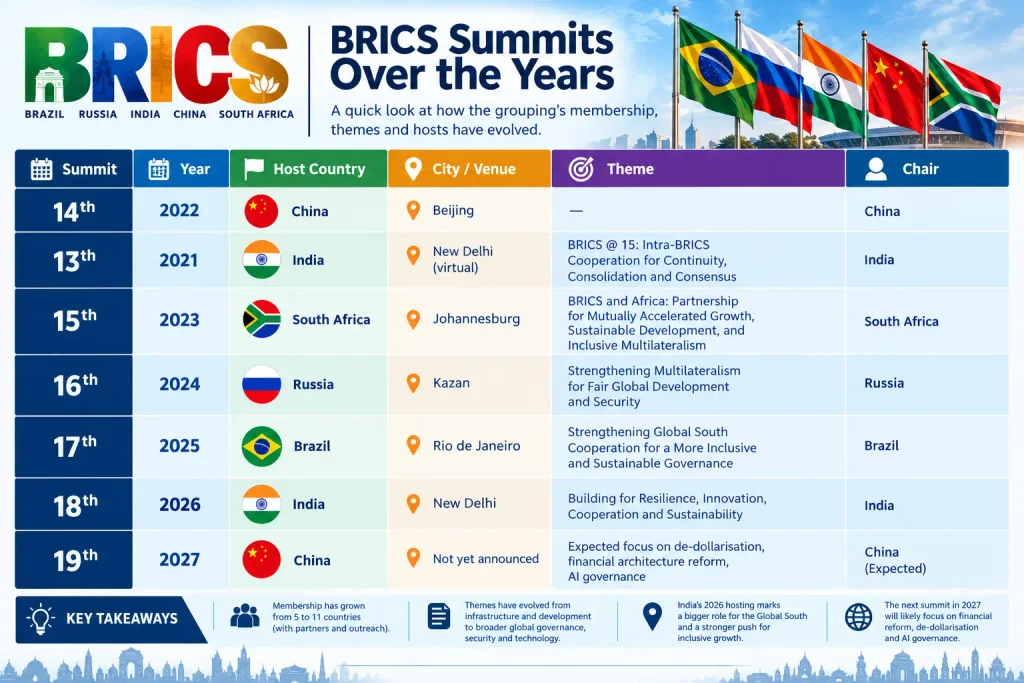
Seeing the last several summits side by side makes it easier to track how the grouping’s membership, themes, and hosts have shifted.
| Summit | Year | Host country | City / venue | Theme | Chair |
|---|---|---|---|---|---|
| 14th | 2022 | China | Beijing | — | Xi Jinping |
| 13th | 2021 | India | New Delhi (virtual) | BRICS @ 15: Intra-BRICS Cooperation for Continuity, Consolidation and Consensus | Narendra Modi |
| 15th | 2023 | South Africa | Johannesburg | BRICS and Africa: Partnership for Mutually Accelerated Growth, Sustainable Development, and Inclusive Multilateralism | Cyril Ramaphosa |
| 16th | 2024 | Russia | Kazan | Strengthening Multilateralism for Fair Global Development and Security | Vladimir Putin |
| 17th | 2025 | Brazil | Rio de Janeiro | Strengthening Global South Cooperation for a More Inclusive and Sustainable Governance | Luiz Inácio Lula da Silva |
| 18th | 2026 | India | New Delhi | Building for Resilience, Innovation, Cooperation and Sustainability | Narendra Modi |
| 19th | 2027 | China | Not yet announced | Expected focus on de-dollarisation, financial architecture reform, AI governance | Expected: Xi Jinping |
A few things stand out here. The 15th summit in Johannesburg was where the group agreed to admit six new members starting January 2024, which is why the 16th summit in Kazan was the first to include Egypt, Ethiopia, Iran, and the UAE. Indonesia’s entry followed in 2025, making the Rio summit the first with Jakarta at the table. Reports on the 2027 chairship indicate Beijing is expected to push harder on cross-border payment systems and IMF reform than India did this year, since New Delhi has consciously kept that language off its own agenda to avoid straining ties with Washington.
Is September 11, 2026 a holiday in Delhi? Full breakdown
This is probably the question that brought a lot of readers here, so it deserves a direct answer before anything else: yes, schools across Delhi are closed on Friday, September 11, 2026, because of the BRICS Summit.
The Directorate of Education issued a circular on September 5 ordering a full-day holiday for that Friday, citing security arrangements for the summit. The order covers every school under the Directorate, government, government-aided, and unaided recognised private schools alike, with no exceptions for particular districts or zones. Offices under the Directorate are shut too, and separately, central and Delhi government offices across the capital are closed that day to reduce congestion during VVIP movement.
A few practical points worth flagging for parents and students:
- The closure is a single day, September 11. It does not automatically extend to September 12 or 13, when the actual leaders’ sessions take place.
- Colleges and universities are not automatically covered by this order. Delhi University, IP University, and individual colleges need to issue their own notices, so students should check institution-specific communication rather than assume classes are cancelled.
- The holiday applies specifically to the National Capital Territory of Delhi. Neighbouring areas such as Noida, Ghaziabad, Gurugram, and Faridabad are not covered unless their own local authorities issue separate orders.
- Exams and parent-teacher meetings scheduled for September 11 will need to be rescheduled by individual schools, since the circular does not prescribe a single uniform replacement date.
Why Delhi is closed on September 11: the case for it
From a security standpoint, the argument is straightforward. A summit bringing together heads of state from eleven member countries, plus outreach invitees, generates an enormous security footprint, road closures, restricted airspace near the venue, VVIP convoys moving through the city at short notice. Trying to run normal school traffic, with buses, private vehicles, and thousands of children crossing the same roads, alongside that kind of movement is a genuine logistical risk, not just an inconvenience. Delhi followed a similar approach for the G20 Summit in September 2023, when schools were closed from September 7 to 10 for the same underlying reason: keeping children out of a security zone that changes shape hour to hour.
There is also a simple traffic-management logic to it. More than 35 roads are expected to face restrictions during the summit, with over 20 diversion points identified. Removing the daily school run from that equation, even for a single day, measurably reduces the number of vehicles the traffic police have to manage around the venue.
Why some argue Delhi should have stayed open
The counterargument, and it is a fair one, is about the cost of lost instructional days. Indian schools already lose a significant number of working days each year to weather closures, pollution-related shutdowns, and event-driven holidays like this one. Every additional closure pushes syllabus completion further back and adds pressure closer to exam season, especially for students in board exam years. Critics of blanket closures argue that a more targeted approach, closing only schools within the immediate security perimeter rather than the entire city, would achieve the same safety goal with far less academic disruption.
There is also a fairness question raised in comparable events elsewhere: children in areas nowhere near Bharat Mandapam, on the far edges of Delhi, are losing a school day for a security concern that barely touches their neighbourhood. This is a genuinely open question in Indian urban policy, not one with a clean right answer, and it comes up every time a major summit or VVIP visit triggers a city-wide rather than zone-specific closure.
Delhi closures for major summits: a quick comparison
| Event | Year | Closure duration | Scope |
|---|---|---|---|
| G20 Summit | 2023 | September 7 to 10 (4 days) | All schools and government offices, city-wide |
| India AI Impact Summit | 2026 | No city-wide school closure ordered | Event confined mainly to Bharat Mandapam traffic zone |
| BRICS Summit | 2026 | September 11 (1 day) | All Directorate of Education schools and offices, city-wide |
Worth noting: the AI Impact Summit in February did not trigger a citywide school holiday despite running for five days and drawing delegations from over 100 countries. That is largely because it did not involve the same density of head-of-state-level VVIP movement through the city that BRICS and G20 both did. It is a useful data point for the “was the closure necessary” debate, since it shows Delhi does not automatically shut schools every time it hosts a large international event. The decision tends to track the security profile of the visiting delegations, not just the size of the event.
BRICS Summit 2026 versus the India AI Impact Summit 2026: how they compare
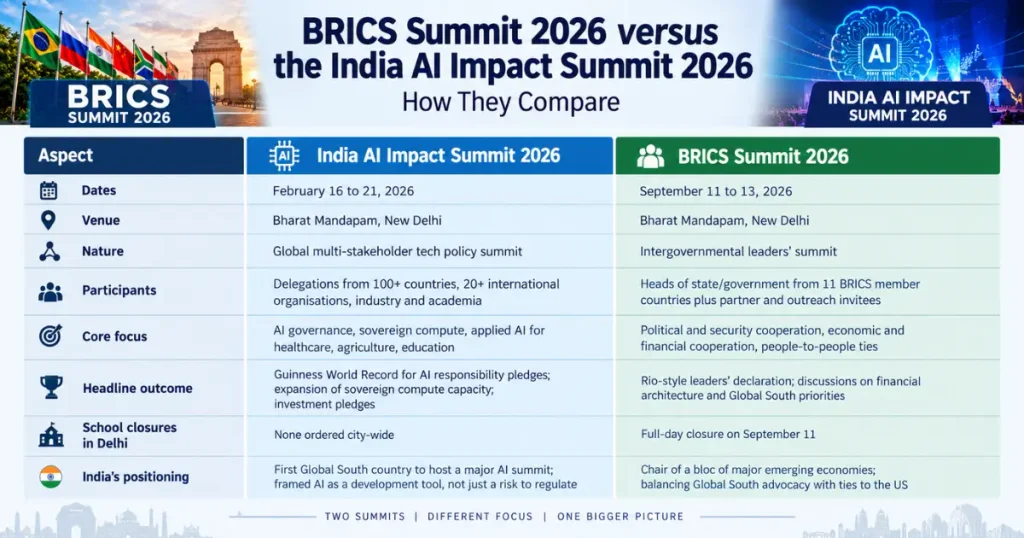
India has now hosted two very different but genuinely significant summits in 2026, seven months apart. Putting them side by side helps clarify what each one was actually for.
| Aspect | India AI Impact Summit 2026 | BRICS Summit 2026 |
|---|---|---|
| Dates | February 16 to 21, 2026 | September 11 to 13, 2026 |
| Venue | Bharat Mandapam, New Delhi | Bharat Mandapam, New Delhi |
| Nature | Global multi-stakeholder tech policy summit | Intergovernmental leaders’ summit |
| Participants | Delegations from 100+ countries, 20+ international organisations, industry and academia | Heads of state/government from 11 BRICS member countries plus partner and outreach invitees |
| Core focus | AI governance, sovereign compute, applied AI for healthcare, agriculture, education | Political and security cooperation, economic and financial cooperation, people-to-people ties |
| Headline outcome | Guinness World Record for AI responsibility pledges; expansion of sovereign compute capacity; investment pledges | Rio-style leaders’ declaration; discussions on financial architecture and Global South priorities |
| School closures in Delhi | None ordered city-wide | Full-day closure on September 11 |
| India’s positioning | First Global South country to host a major AI summit; framed AI as a development tool, not just a risk to regulate | Chair of a bloc of major emerging economies; balancing Global South advocacy with ties to the US |
The AI summit was framed around a shift in the global conversation, away from the risk-and-safety language of earlier summits in Bletchley, Seoul, and Paris, and toward a “diffusion and development” framing that centres the Global South’s needs. Brookings researchers who attended described this as part of a broader shift where sovereignty debates are becoming more practical and diffusion is reshaping how countries think about AI policy. India used it to promote its Digital Public Infrastructure model as something other developing nations could adapt.
BRICS, by contrast, is not a single-issue summit. It spans trade, security, health, counter-terrorism, and financial cooperation across a bloc that already represents a meaningful share of global GDP and population. Where the AI summit was about India shaping the future of one specific technology, BRICS is about India managing a much wider and more established set of relationships, some cooperative, some genuinely tense, particularly with China.
Taken together, the two summits tell a consistent story about 2026: India spent the year positioning itself as a country capable of running the agenda on both cutting-edge technology policy and legacy multilateral diplomacy, in the same venue, within the same calendar year.
What this means for ordinary citizens
Beyond the diplomacy, there are a few practical takeaways for people living through this week in Delhi, and for anyone following the summit from elsewhere in India.
For Delhi residents, the near-term impact is traffic and school disruption, which passes once the summit ends on September 13. Commuters heading to airports or railway stations have been advised to leave earlier than usual and rely on public transport where possible.
For the country more broadly, the summit’s real impact plays out over months, not days, through the declarations and agreements signed at Bharat Mandapam. Outcomes on trade facilitation, technology cooperation, or New Development Bank funding tend to filter down slowly, through ministries, trade policy, and eventually into things like export opportunities for Indian businesses or funding for infrastructure projects in partner countries.
It is worth being honest that summits like this do not change daily life overnight. Their value is cumulative: each one adds to India’s diplomatic standing, keeps doors open with a large bloc of trading partners, and builds the kind of institutional relationships that matter when India needs support on unrelated issues, whether that is a UN Security Council reform push or a trade dispute with a Western partner.
This article was published on ClarityWire, an educational platform covering political analysis and current affairs, with inputs from Ashutosh Bhatt. For queries, corrections, or feedback on this piece, please get in touch through the site.